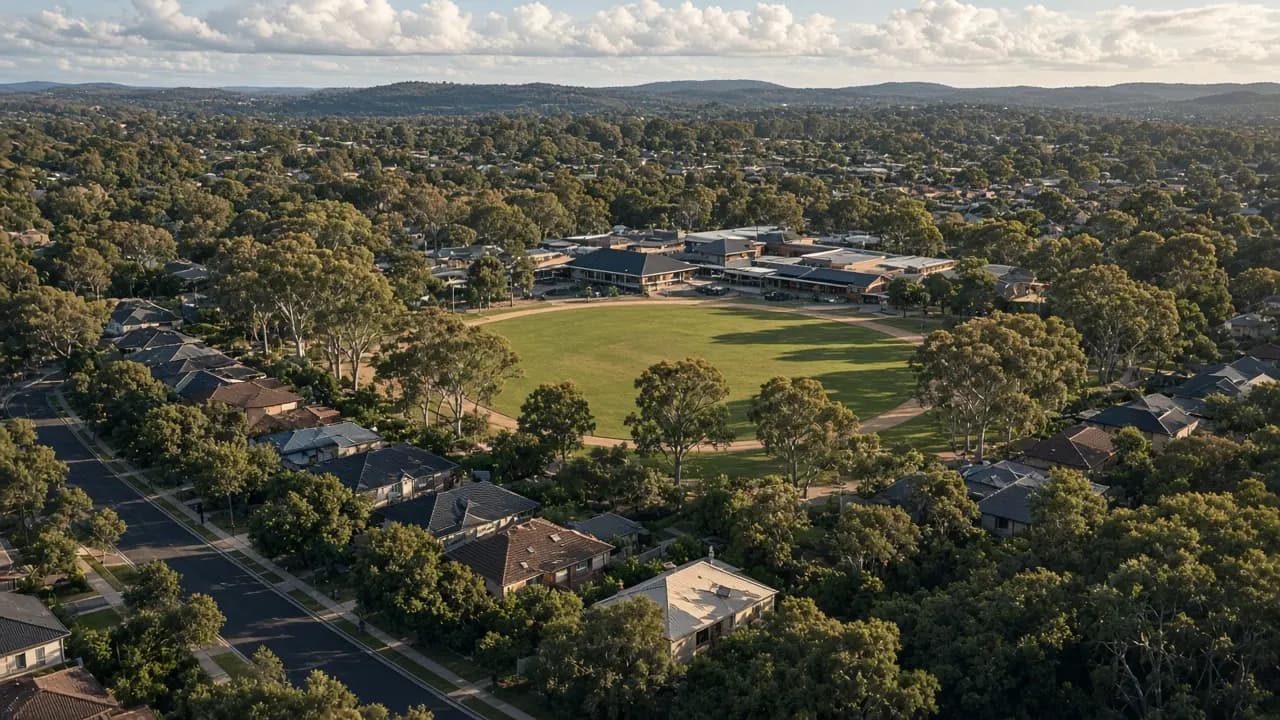
A school catchment is a planning tool, not a rumour. In Australian government schooling it is the residential area a public school is designated to serve. Live inside it, and the usual rule is that your child can enrol there. Live outside it, and you may still apply, but the school is allowed — and in busy suburbs required — to protect places for families who do live inside the line.
The line itself is drawn by the state or territory education department, not by this site, not by a real-estate agency, and not by a school’s social-media page. The vocabulary changes. New South Wales speaks of catchment zones or local enrolment areas. Victoria speaks of school zones and a designated neighbourhood government school. Queensland speaks of catchment areas and School Enrolment Management Plans. Western Australia speaks of local-intake areas. South Australia speaks of school zones. Tasmania speaks of intake areas. The ACT and the Northern Territory speak of priority enrolment areas. The idea underneath is the same.
This page explains that idea, names the official maps, and describes how out-of-area applications usually sit behind local ones. It does not draw a map of your street. Only the department tool can do that for the year you need.
Why zones exist
Public schools are built to be reachable. If every family could insist on the same campus, the campus nearest a train line or a new housing estate would overflow while the next school sat half empty. Catchments spread enrolment, keep a right of access for local children, and give principals a fair rule when they have to say no.
They also give families a starting point that is not a ranking. The designated school is not “the best school”. It is the school the system has promised to keep a place in for the children who live around it. That promise is the public part of public education. Everything else — specialist programs, music, sport, a quieter playground — is a preference you can pursue after the local right is understood.
The official map is the only map that counts
Each jurisdiction publishes a finder or a map. Use it with the address where the child will actually live on school days, and with the enrolment year you care about. Victoria’s Find my School tool, for example, asks for an enrolment year because next year’s zone can differ from this year’s. Other departments update maps when schools open or change.
Official starting points include:
- NSW School Finder from the NSW Department of Education.
- Find my School from the Victorian Department of Education.
- Queensland Government catchment guidance and EdMap.
- Western Australia’s Schools Online / find-a-school search via the WA Department of Education.
- South Australian zone maps and the Department for Education find-a-school tool.
- Tasmania’s intake-area map via the Department for Education, Children and Young People.
- ACT Priority Enrolment Area information on act.gov.au.
- Northern Territory priority enrolment area maps via the NT Department of Education and Training.
If two tools disagree, the department tool wins. If a school website and the finder disagree, ask the school to explain, then still keep a copy of the finder result. If you are buying or renting, make the contract rest on the official map checked on the day, not on a listing from the week the property was photographed.
Victoria’s school-zone guidance is unusually plain on this point: the department does not endorse zone advice from real-estate agents or other websites, and Find my School is the official source. Treat that as a national principle even where other departments use fewer words.
How a local place is decided
Most systems use a permanent residential address. Temporary stays, shared care, and recent moves are the hard cases.
Shared care. If a child lives in two homes, departments usually have a rule about which address is the enrolment address — often the one where the child lives most of the time, or an address nominated with evidence. Ask the school how it applies the local policy rather than assuming the closer school automatically wins.
New housing. Occupancy dates matter. A contract to buy is not always enough if the family cannot yet live there. Conversely, a short-term lease at the new address may be enough if it is genuine. Schools are used to this; they still need documents.
Rural measurement. Some systems measure the local school as the nearest by straight line in a city and by practical road route outside it. Victoria describes that distinction on its school-zone pages. Queensland describes the local state school as the closest by the shortest most direct route by road to the main entrance. Do not assume the pin on a phone map matches the department’s rule.
Shared zones. In the ACT, some suburbs are assigned to more than one school. A shared Priority Enrolment Area still guarantees a public-school place, but not necessarily at the preferred campus. Read the suburb listing on the ACT page rather than picking a school from a street directory.
Out-of-area applications sit behind local ones
Every jurisdiction allows families to apply outside the designated area. None of them makes that application equal to a local one.
Typical reasons a family applies out of area include a parent’s workplace, a sibling already at the school, a specialist program, or a preference formed after a visit. Typical reasons a school declines include classroom capacity, the need to keep spare places for families who will move into the catchment during the year, and the need to keep class sizes even across year levels. Queensland’s catchment guidance lists those operational tests in plain language. Other departments encode them in placement policies and enrolment-management plans.
If you apply out of area:
- Enrol locally as well, or at least know which school is obliged to take you, so the child is not left without a place.
- Lodge the out-of-area application in the form the school actually uses. Tasmania, for example, refers to an expression-of-interest process once a school has capacity.
- Provide the evidence the procedure asks for, not a longer story than was requested.
- Accept that a waiting list is not a promise.
Do not pay a third party to “get you into the zone”. Proof of residence that is not genuine can unpick an enrolment later. Schools are entitled to check.
When a school has an enrolment management plan
Busy schools publish extra rules for leftover places. Queensland’s School Enrolment Management Plans are the clearest national example: they exist so local students still have a place, and so out-of-catchment applications are assessed in a stated order. Western Australian local-intake areas play a similar role when applications exceed places. NSW schools with high demand apply local enrolment-area rules in the same spirit.
If the school you prefer has such a plan, read it on the department or school site. It will not usually create a new right; it will describe how scarce leftover places are allocated.
Schools that are not zoned in the ordinary way
Catchment logic does not cover every government campus. Academically selective high schools and opportunity classes, selective-entry schools in Victoria, Queensland Academies, and gifted-and-talented programs in Western Australia use tests and published eligibility rules. Some specialist schools for students with disability use different entry pathways. Some language schools, outdoor-education campuses, and flexible-learning settings do too.
If the program is selective or specialist, the selective schools guide and the department’s own program page are the right documents. Using a neighbourhood map to argue for a place in those settings will not help.
Distance education has eligibility tests of its own, often tied to remoteness, travel time, or individual circumstances. Those tests are departmental, not geographic in the suburban sense.
How to read My School alongside a zone
ACARA’s My School website is a school profile tool. It is not a catchment map and it does not decide eligibility. Once you know which schools you are entitled or eligible to apply to, My School can show published information about each campus. It should not be turned into a ranking, and this site will not do that for you. Combine the official zone, the school’s own voice, and a visit. That is the whole method.
A short working sequence
Find the designated school on the official map for the enrolment year. Save or print that result. Contact the school about enrolment. If you still want a second government school, treat it as an out-of-area application and keep the local school as the guaranteed path. If the finder result surprises you — a road that looks closer, a new estate, a shared zone — ask the department how the area was measured, rather than arguing from a maps app.
For the paperwork that follows the map, return to enrolment. For the judgement between two eligible schools, continue to choosing a public school. For the finder that applies to your address, open the state and territory hubs.