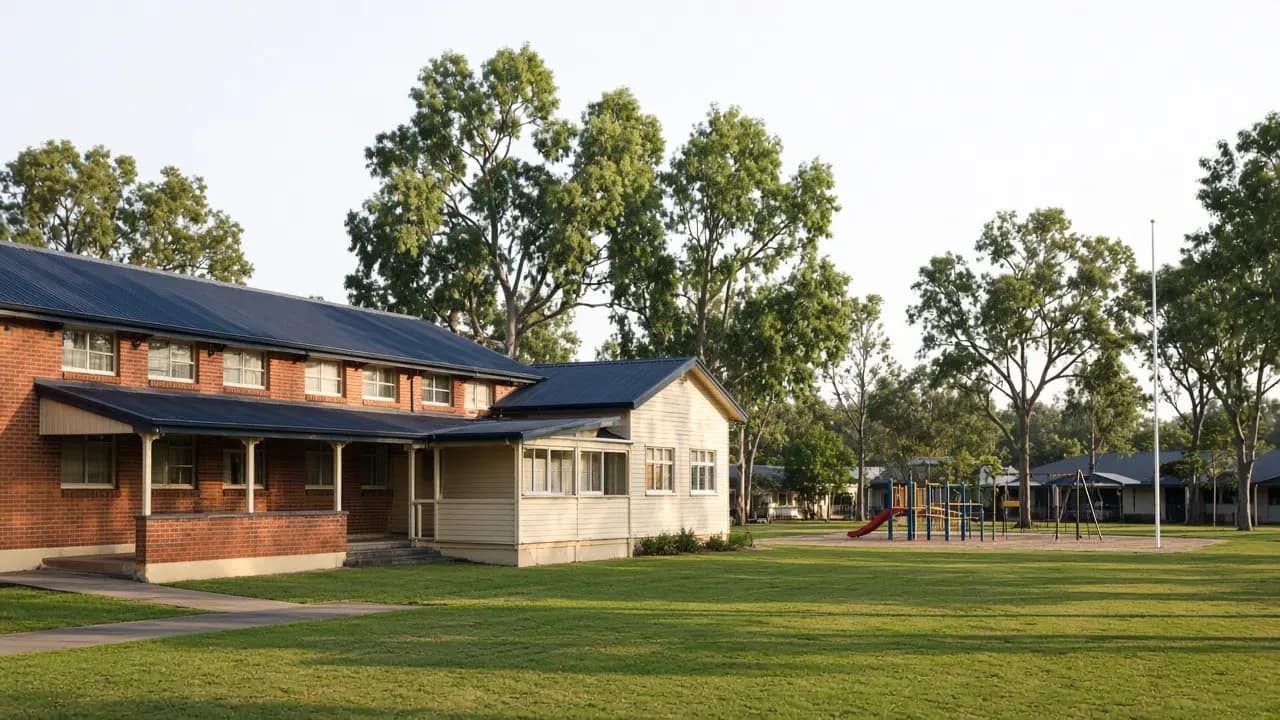
Public schooling in Australia is local even when the building looks familiar. There is no single national enrolment desk, no one catchment map, and no official ranking that tells a family which government school to pick. Each state and territory education department sets starting ages, term calendars, local-intake rules and selective-entry tests. The school you can actually enrol in is the one that belongs to the system where you live.
This guide exists to make that split visible. It explains the shared ideas — a local school, a proof-of-address check, a first year of school with a local name — and then sends you to the department pages that carry the current rule. It is written for families who are new to a suburb, new to the country, or simply new to the paperwork. It is not an enrolment portal, not a wait-list, and not a substitute for the school.
What a public school is, in Australian terms
A public school here is a government school. It is established and funded through the state or territory, follows that jurisdiction’s policies, and teaches toward the Australian Curriculum as implemented locally. Catholic and independent schools sit outside that system. They have their own enrolment rules and fees; they are not covered as operators on this site.
Government schools include primary schools, secondary or high schools, combined K–12 or P–12 campuses, schools for specific purposes, distance-education settings, and a smaller set of academically selective or specialist programs. The labels change. New South Wales still speaks of Kindergarten; Victoria’s first year is Foundation, often still called Prep; South Australia’s first year is Reception. Those names matter when you fill in a form, because using the wrong one can send you to the wrong page.
What does not change is the basic public promise: eligible children who live in a school’s designated area are meant to have a place at that school. How the area is drawn, what evidence counts as “living there”, and how leftover places are offered to families outside the area are all local questions. The enrolment guide walks through the usual documents. The catchment guide explains why the map on a real-estate listing is not the map that counts.
Start with the address, not the rumour
The practical first step is always the same. Enter the residential address where the child will live during the school week into the official finder for that jurisdiction. In New South Wales that is the NSW Department of Education School Finder. In Victoria it is Find my School. In Queensland, Western Australia, South Australia, Tasmania, the ACT and the Northern Territory, the education department publishes its own catchment, intake or priority-enrolment map. Each state hub on this site names the current official tool.
Do that before you tour a school that a neighbour liked, and before you treat a property listing as a guarantee. Departments change zones when new schools open, when demand shifts, or when a campus changes the years it offers. A printed brochure from last year can be wrong. So can a screenshot in a social group.
Once you know the designated school, contact it. Ask how that campus takes enrolment applications for the year you need, what evidence of age and residence it wants, and whether orientation or transition sessions are planned. If you hope to apply outside the area, ask whether the school is even considering those applications. Capacity is not something this site can see.
Choosing without inventing a ranking
Families often want a shortlist. That is reasonable. It is also where unofficial websites go wrong, by turning NAPLAN numbers or real-estate chatter into a league table. ACARA’s My School website exists so you can read a school’s profile, including context about the community it serves. My School’s own terms of use warn against treating any single indicator as the whole story, and against building commercial comparison lists from its content. This guide follows that warning. It does not publish rankings, scores or fees.
A more useful shortlist is small and grounded. Visit the designated local school. If the department finder also shows nearby government schools, note them as possible out-of-area options only. Read each school’s own site for curriculum offerings, specialist programs, and how it describes student wellbeing. Ask about before- and after-school care as a practical matter, not as a status marker. Then decide. The choosing a public school guide sets out that sequence in more detail.
Some families will also look at academically selective public pathways. Those are not a parallel “better” system; they are additional, test-based programs with their own calendars and eligibility rules, and they do not exist in the same form everywhere. See selective schools.
Calendars, starting ages, and why this site will not invent dates
Term dates are published by each department, usually as a four-term year with student-free days attached. They are not the same in every state, and Western Division schools in New South Wales, some border schools, and a small number of remote campuses can follow a different calendar. This site does not reprint those dates, because reprinted dates go stale and because inventing a date would be worse. Use the school terms page to reach the official calendar.
Starting-age rules are also departmental. As a national picture, most children begin the Foundation year around the year they turn five, and schooling becomes compulsory at an age set in local law — commonly six, with different wording in Queensland and Western Australia. Cut-off birthdays differ. Confirm them on the department page, then talk with the school if your child is close to the line. The enrolment guide summarises where those rules live without treating this page as the legal text.
How to use this site
Read the national guides when you need the process. Open the hub for the state or territory where the child will live when you need the finder, the department name, and the local vocabulary. If you are moving interstate, do both: the old system does not automatically transfer a place, and the new system will want its own proof of address.
If you came here from an old bookmark, you are in the right place. The guides above are the current public school pages for this domain. For questions that are really about a particular campus — a wait-list, a specialist class, a bus — the only authoritative answer is the school or the department, not a national explainer.
Public schools remain the default setting for most Australian families because they are designed to be reachable from where people live. The work of this guide is to keep that design visible: find the local school on an official map, enrol with the documents the school asks for, and treat everything else — including this site — as context, not as a decision made on your behalf.